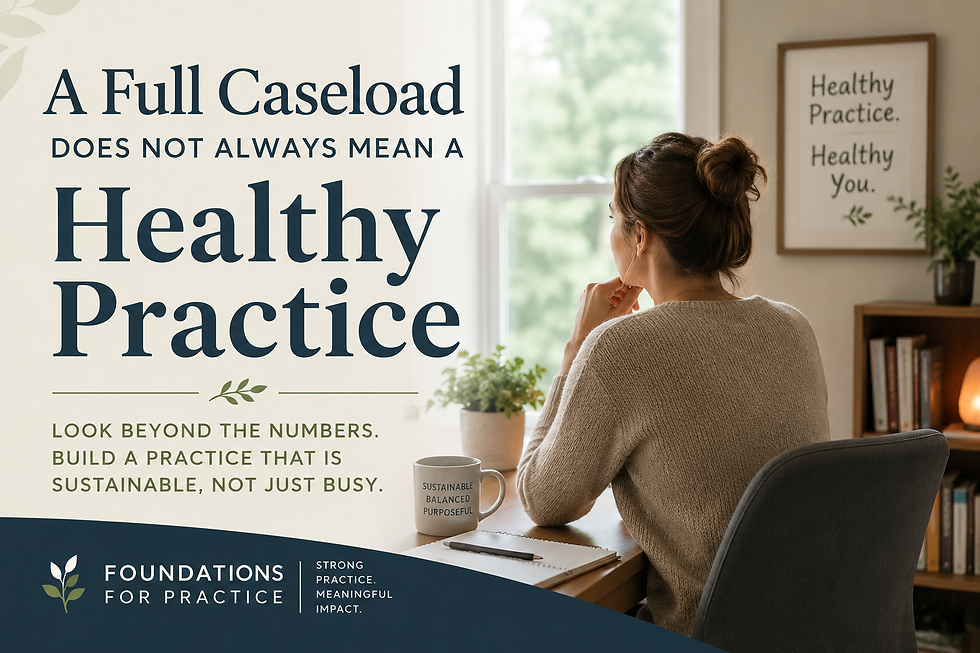
Why Some Practices Feel Sustainable and Others Constantly Feel Fragile
- Foundations For Practice

- May 25
- 4 min read

Two clinicians can appear very similar on paper while having completely different experiences of private practice internally.
Both may have full caseloads.
Both may earn comparable income.
Both may have steady referrals.
Both may appear professionally successful from the outside.
And yet one practice may feel relatively stable and manageable while the other feels as though it could become overwhelming or unstable at any moment.
This is one of the quieter realities of private practice that many clinicians struggle to fully explain: outward indicators of success do not always reflect how sustainable a practice actually feels to live inside.
Part of the difficulty is that clinicians often evaluate practice health through highly visible metrics: caseload size, income, referral volume, growth, or productivity.
Those things matter. A practice without financial sustainability or referral stability creates very real strain.
But many therapists eventually discover that sustainability depends on far more than whether the schedule is full.
Some practices feel fragile because the entire structure operates with very little margin.
Financially. Emotionally. Operationally. Relationally.
There may be very little room for: illness, time off, slower referral periods, family responsibilities, burnout, unexpected expenses, or changes in capacity.
In these situations, even relatively small disruptions can begin feeling psychologically threatening because the practice requires continuous stability in order to keep functioning comfortably.
Over time, that level of pressure can create chronic vigilance.
Many clinicians begin organizing decisions around avoiding instability: overextending availability, maintaining workloads beyond sustainable limits, continuing to accept referrals despite exhaustion, avoiding vacations, or constantly monitoring the schedule for signs that something may be slowing down.
Eventually, the practice itself can begin feeling emotionally difficult to regulate.
This is one of the reasons sustainability is often less about how much a practice is producing and more about how much pressure the structure requires the clinician to continuously absorb.
Some practices appear successful externally while quietly depending on chronic overfunctioning from the person maintaining them.
That is rarely sustainable indefinitely.
Other practices feel more stable not necessarily because they are larger or more profitable, but because the structure itself contains more flexibility, support, proportionality, and margin.
The clinician may have: clearer systems, healthier financial buffers, more manageable workload expectations, stronger boundaries, administrative support, better referral consistency, or simply a practice structure that aligns more realistically with their actual capacity and life circumstances.
Importantly, sustainability is rarely created through one single change.
It is usually the cumulative effect of multiple areas functioning reasonably well together.
Financial margin matters.
Operational systems matter.
Referral consistency matters.
Boundaries matter.
Recovery matters.
Support matters.
Workload matters.
Life circumstances matter.
And these areas tend to interact with one another continuously.
For example, a clinician may technically earn enough income but still feel fragile because the administrative load is overwhelming. Another therapist may have strong systems but very little financial margin, creating constant anxiety during normal fluctuations. Someone else may have a manageable workload but very little support outside work, leaving almost no room for recovery when stress increases elsewhere in life.
This is part of why sustainability often feels more complicated than many clinicians initially expect.
A practice can look stable externally while functioning very precariously internally. And because many therapists are highly capable professionals, clinicians often adapt to unsustainable structures for long periods of time before fully recognizing how much strain has accumulated.
Sometimes the issue is not clinical work itself.
Sometimes it is the cumulative pressure of carrying too many unstable systems simultaneously.
One of the more difficult aspects of private practice is that many clinicians unconsciously organize their practices around fear rather than sustainability.
Fear of financial instability. Fear of losing referrals. Fear of slowing down. Fear of disappointing clients. Fear of uncertainty. Fear of not being “successful enough.”
Over time, practices built primarily around preventing anxiety often become increasingly difficult to inhabit comfortably.
This is why some clinicians eventually discover that sustainability requires more than simply increasing income or filling the schedule further.
Sometimes sustainability improves through simplification rather than expansion.
Better systems. Clearer boundaries. Reduced operational complexity. More realistic workload expectations. Increased financial margin. Additional support. More recovery. Or simply allowing the structure of the practice to become more proportionate to the actual human being maintaining it.
That distinction matters considerably.
Because ultimately, a sustainable practice is not necessarily the practice that grows the fastest, earns the most, or looks the most impressive externally.
Often, it is the practice that clinicians can realistically continue living inside long term without constantly feeling as though everything depends on their ability to keep absorbing more pressure.
Explore the Health of Your Practice More Clearly
Sometimes the issue is not only workload or referrals. Sometimes the overall structure of the practice itself has become too financially, operationally, or emotionally fragile to sustain comfortably over time.
FOUNDATIONS FOR PRACTICE offers a free reflective Business Health Diagnostic designed to help clinicians think more clearly about sustainability, workload, financial pressure, operational strain, referral stability, and the broader health of their practice.